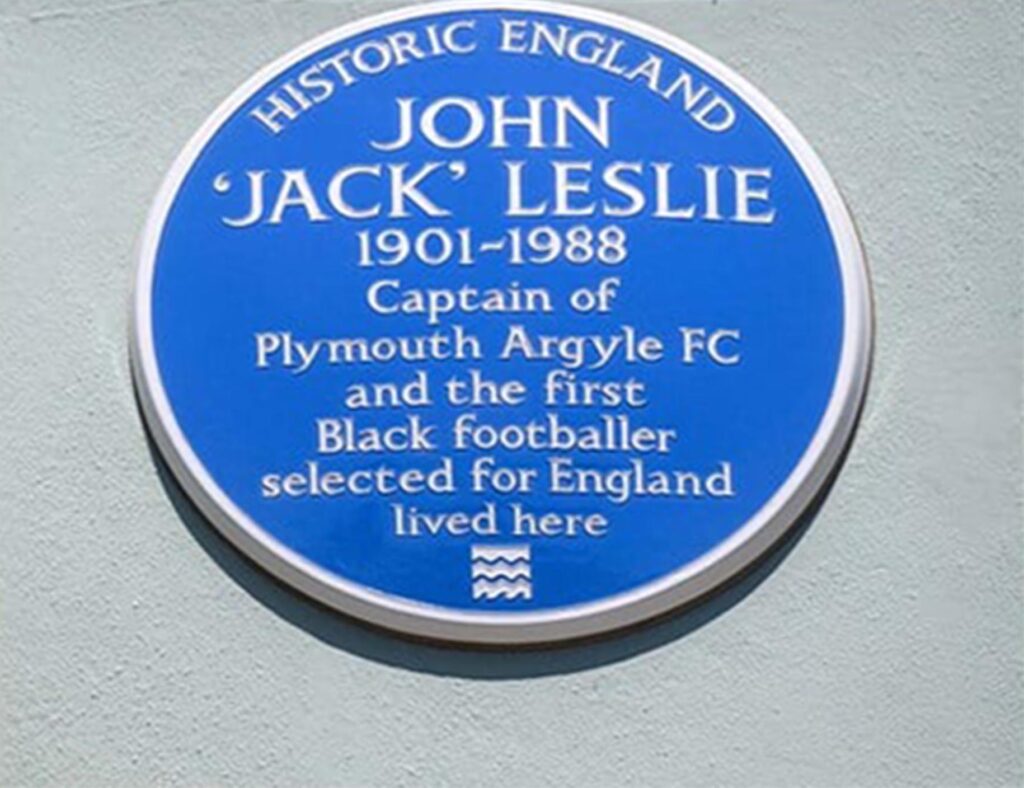
Following the unveiling of the bronze statue at the Plymouth Argyle stadium to commemorate Argyle player Jack Leslie, the first black player to receive an England cap, a blue plaque in his honour has been unveiled at his former home at 8 Glendower Road, Peverell. The inscription on the plaque reads: JOHN ‘JACK’ LESLIE 1901 – 1988 Captain of Plymouth Argyle FC and the first Black footballer selected for England lived here.
The unveiling was led by Historic England’s chief executive Duncan Wilson, alongside Leslie’s granddaughters Lesley Hiscott, Gillian Carter and Lyn Davies. John ‘Jack’ Leslie, who scored 137 goals in 400 appearances for Plymouth Argyle between 1921 and 1934, was called up to play for the national team 100 years ago in 1925.
Sadly the striker was denied any actual England appearance after selectors discovered his heritage.
However he continued to excel at Plymouth Argyle and his significance in the history of English football has now thankfully been acknowledged and celebrated.
Three years ago, the FA presented his family with a posthumous cap and apologised by acknowledging that the retraction of his call-up ‘should never have happened’.
That Jack has finally been recognised in this way is largely down to OPM Matt Tiller (90) and Greg Foxsmith, co- founders of The Jack Leslie Campaign, who raised £140,000 to erect the statue at Plymouth Argyle three years ago. Matt says: ‘100 years ago, Plymouth Argyle’s Jack Leslie was a young newlywed with the world at his feet. ‘He walked from this house to Home Park where he was given the fantastic news that is so significant in the history of our national sport.
‘Jack had been picked for England, the first player of colour to be selected. He returned to Glendower Road to share that achievement with his new wife, Win. And it was here that he would later have to deal with that dream being snatched away. But he bounced back, helping Argyle win promotion and becoming team captain.
‘It also became a family home after his daughter Evelyn came along in 1927. ‘It is a wonderful moment to see Jack recognised and celebrated here with a blue plaque.’